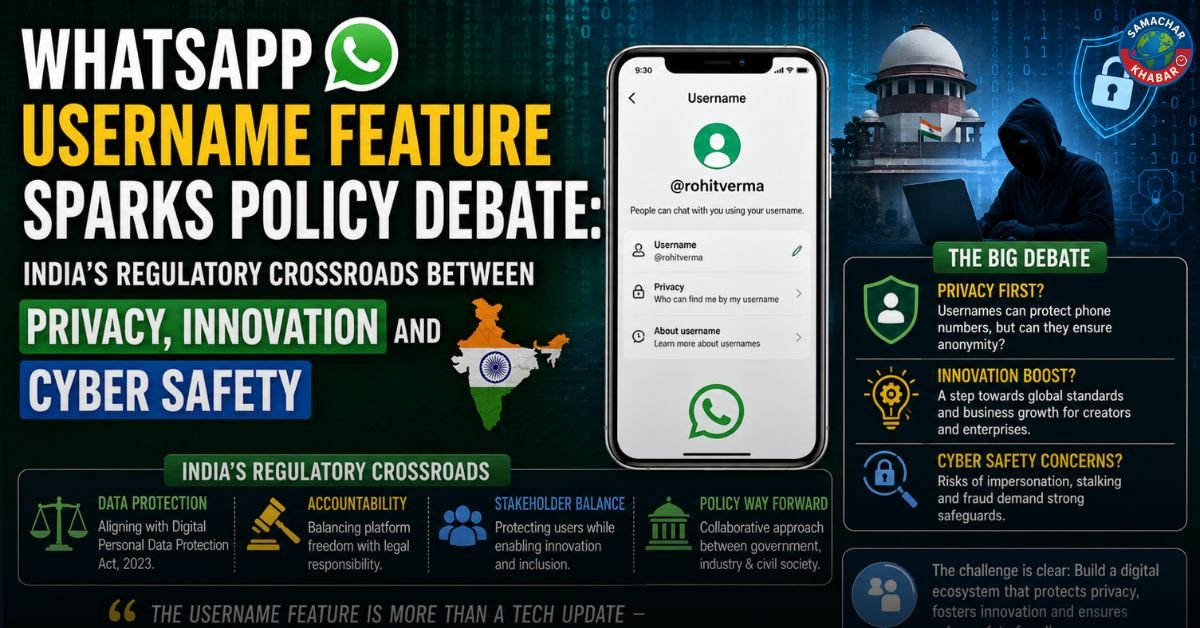
WhatsApp Username Feature: A reported move by the Government of India to seek a pause on WhatsApp’s upcoming username feature has triggered a wider debate over how India should regulate emerging digital technologies. While officials have expressed concerns that the feature could create fresh opportunities for cyber fraud and impersonation, legal and technology experts argue that the discussion goes far beyond a single messaging application. Instead, they say, it highlights a fundamental question for India’s digital future: should regulators focus on controlling technology features, or on preventing the harms that misuse of those features can cause?
The debate gained momentum after the Ministry of Electronics and Information Technology (MeitY) reportedly sent a notice to WhatsApp and its parent company Meta, asking them to pause the rollout and provide an explanation of the feature within days. According to reports, the government cited concerns under the Information Technology Act and the intermediary rules. India remains WhatsApp’s largest market, making the regulatory decision particularly significant for both users and the company.
What Is the WhatsApp Username Feature?
The proposed feature would allow users to communicate using unique usernames instead of sharing their personal mobile phone numbers. The objective is to strengthen user privacy by reducing the need to disclose a personal contact number before initiating conversations.
However, government officials are reportedly concerned that such usernames could make it easier for fraudsters to impersonate public figures, government institutions, businesses and other trusted organizations. Authorities fear that cyber criminals could exploit deceptive usernames to expand phishing operations, financial scams and the increasingly common “digital arrest” frauds that have emerged across India.
The concern reflects the government’s broader focus on tackling cyber crime, an issue that has become a major challenge amid the country’s rapidly expanding digital ecosystem.
Indian Express Opinion Piece Offers a Different Perspective
An opinion article published in The Indian Express on July 3, 2026, authored by Srinath Sridharan and Anand Venkatanarayanan, argues that the controversy represents a larger policy challenge rather than merely a dispute over a WhatsApp feature.
According to the authors, the government’s reported response risks regulating product design instead of regulating actual harms.
They contend that usernames do not fundamentally weaken law enforcement capabilities because every WhatsApp account continues to remain linked to a verified mobile phone number. Therefore, investigators retain the ability to identify users through established legal processes.
The authors also point out that impersonation is hardly a new phenomenon. Similar risks already exist across emails, SMS messages, voice calls and multiple social media platforms, yet governments generally do not prohibit those communication architectures solely because they can be misused.
In their view, the existence of misuse should not automatically justify blocking technological innovation.
Privacy Gains Could Align With India’s Data Protection Vision
The article further argues that usernames may actually improve digital privacy by reducing unnecessary sharing of personal phone numbers.
This privacy benefit, the authors suggest, aligns with India’s broader data protection objectives by giving users greater control over their personal information.
Instead of exposing a permanent phone number to strangers, users would be able to interact through usernames, thereby reducing certain forms of spam, unwanted contact and privacy risks.
Supporters believe such privacy-enhancing features represent the next stage in secure digital communication, especially as concerns over personal data continue to grow.
Feature Regulation Versus Harm Regulation
One of the central themes of the opinion piece is the distinction between regulating features and regulating harms.
The authors advocate a principle-based, technology-neutral regulatory framework that focuses on outcomes rather than attempting to pre-approve every new product innovation.
They argue that technology evolves much faster than regulation, making feature-by-feature oversight increasingly impractical. Instead, policymakers should establish clear obligations requiring platforms to prevent foreseeable harms, cooperate with law enforcement and rapidly address abuse regardless of how their products are designed.
Such an approach, they say, would create a more predictable regulatory environment while allowing innovation to continue.
Suggested Safeguards Instead of an Indefinite Freeze
Rather than opposing regulation altogether, the opinion piece recommends several safeguards that could address legitimate security concerns without blocking the feature.
Among the proposed measures are privacy-preserving default settings that require user consent before unknown individuals can initiate conversations through usernames.
The authors also recommend stronger verification mechanisms for official government accounts, public institutions and recognized organizations to reduce impersonation risks.
Additional suggestions include deploying artificial intelligence systems capable of detecting deceptive usernames, strengthening grievance redressal mechanisms for victims of impersonation and ensuring faster cooperation between platforms and law enforcement agencies whenever abuse occurs.
These safeguards, they argue, would directly target cyber crime instead of restricting innovation itself.
Government’s Concerns Reflect India’s Cyber Crime Reality
The government’s cautious approach is rooted in genuine concerns. India has witnessed a sharp increase in cyber fraud, phishing operations and sophisticated financial scams, including so-called “digital arrest” frauds, where criminals impersonate law enforcement or government officials to extort victims.
Officials believe high-impact platforms with hundreds of millions of users require greater scrutiny before introducing features that could potentially be exploited at scale. The existence of end-to-end encryption also limits certain forms of platform visibility, adding another layer to the regulatory discussion.
From this perspective, seeking clarification before rollout is viewed as a reasonable precaution rather than outright opposition to technological advancement.
The Larger Policy Debatoe: Innovation Versus Safety
At the same time, critics caution against setting a precedent where every privacy or security trade-off becomes a regulatory barrier.
Impersonation already occurs through spoofed phone numbers, fake email addresses and fraudulent social media profiles. Blocking one feature, they argue, does not eliminate the underlying criminal behaviour.
A more sustainable strategy would hold platforms accountable through rapid takedowns, trusted verification systems, effective reporting mechanisms and stronger enforcement against offenders.
There is also concern that excessive feature-level regulation could slow India’s ambitions of becoming a global leader in artificial intelligence and digital innovation. Technology experts argue that outcome-focused regulation scales better because governments cannot realistically evaluate every interface change or product update before deployment.
A Balanced Path Forward
A balanced regulatory approach may ultimately offer the most effective solution.
Instead of freezing innovation indefinitely, regulators could require robust safeguards before launch, including default restrictions on unsolicited username-based messages, highly visible verification for sensitive entities, comprehensive audit trails available through lawful processes and continuous monitoring of real-world impacts after deployment.
If evidence later demonstrates significant misuse, regulations could then be refined based on measurable outcomes rather than hypothetical risks.
The WhatsApp username debate therefore reflects a much broader global conversation about balancing privacy, public safety, innovation and effective law enforcement. As India continues expanding its digital economy, the decisions made today could shape not only messaging platforms but also the country’s overall philosophy toward regulating emerging technologies and artificial intelligence in the years ahead.