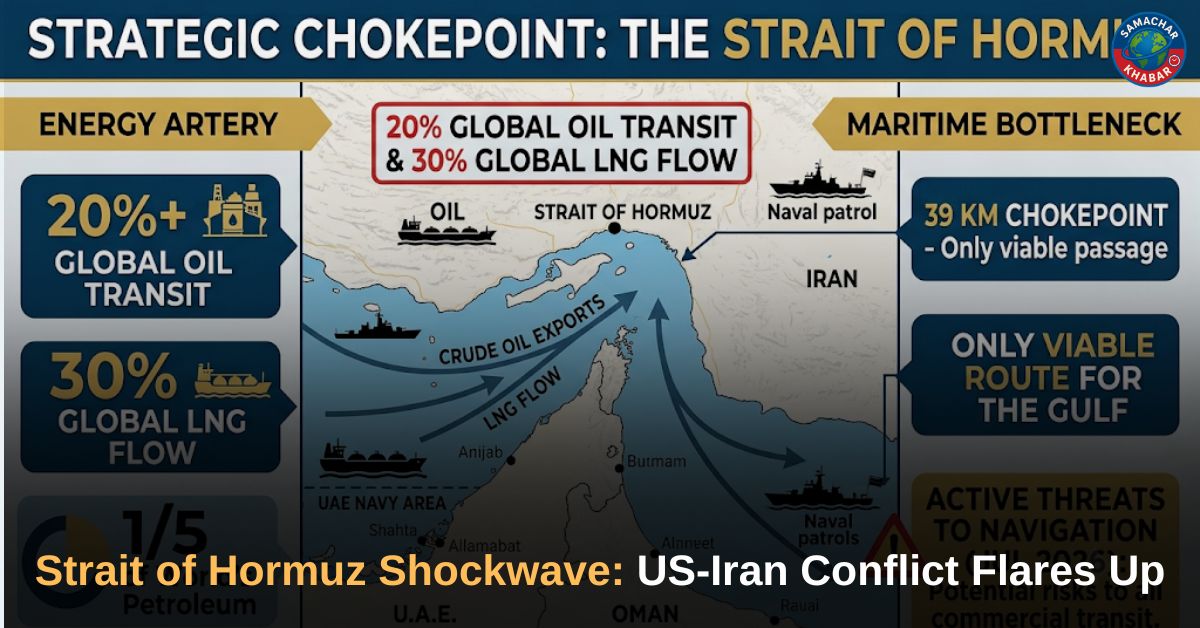
A volatile international crisis has erupted in West Asia as the fragile 14-point truce signed on June 17 collapsed under a sudden resurgence of hostile military strikes between the United States and Iran. The dramatic escalation has forced the UN International Maritime Organization (IMO) to issue an emergency advisory, telling all global commercial transit to completely avoid the Strait of Hormuz.
The freeze of this critical maritime choke point-which facilitates the movement of nearly 20 percent of the world’s oil and liquefied natural gas (LNG)-has triggered immediate turmoil in global energy markets and left hundreds of massive cargo vessels stranded at sea.
Truce Shatters in the Gulf
Resurgence of Military Standoff
The short-lived calm achieved by the mid-June diplomatic agreements vanished overnight following targeted missile and drone exchanges in the waters surrounding the Arabian Gulf. While both Washington and Tehran trade blame for violating the terms of the truce, the real-world consequence was an immediate threat to freedom of navigation.
Recognizing the extreme danger of anti-ship munitions and naval interceptions, international bodies moved swiftly to protect civilian crews. The IMO’s directive to halt shipping through the channel marks one of the most severe maritime security interventions in recent history.
Strait of Hormuz Gridlock
Unprecedented Maritime Halt
The decision to freeze traffic through the 39-kilometer-wide passage has immediate, profound impacts on international supply logistics. Shipping companies have ordered fleets to drop anchor in the Gulf of Oman or seek long, expensive detours around the African continent.
| Maritime Metric | Impact & Volume |
| Global Petroleum Transit | Halts roughly 20 to 21 million barrels of crude oil per day. |
| Global LNG Supplies | Freezes over 20 percent of international liquefied natural gas movement. |
| Stranded Fleet | Estimated 150+ commercial vessels currently halted or rerouted. |
Thousands of merchant seafarers now find themselves caught in political crossfire, waiting in high-risk zones as diplomatic channels scramble to defuse the situation.
Economic and Regional Aftershocks
Global Energy Anxieties
Although the International Monetary Fund (IMF) noted in its July economic outlook that global markets have maintained broad structural resilience this year, the sudden blockade is testing those limits. Crude oil futures spiked by more than 8 percent within hours of the advisory, raising fears of a renewed inflationary wave that could complicate policy decisions for global central banks.
Industry Warning: “A prolonged closure of the Strait of Hormuz is the ultimate worst-case scenario for energy logistics. There is simply not enough pipeline bypass capacity in the world to replace this volume,” warned a leading maritime energy analyst.
Domestic Tensions in Tehran
The timing of the military flare-up coincides with intense internal political changes within Iran. Massive public funeral processions have been taking place across Tehran for the country’s late supreme leader. The heightened national sentiment has amplified state rhetoric, leaving neighboring Gulf nations on high alert as military forces mobilize along the coastlines.
Alternative Energy Routes Under Scrutiny
The disruption has renewed global focus on alternative energy corridors and strategic petroleum reserves. Governments and energy companies are accelerating discussions on expanding pipeline networks, increasing storage capacities, and diversifying import sources to reduce dependence on a single maritime chokepoint. The crisis underscores the importance of building resilient supply chains capable of withstanding geopolitical shocks.
Diplomacy Takes Center Stage
As tensions mount, diplomatic efforts by regional powers and international organizations have intensified. Emergency consultations, back-channel negotiations, and calls for restraint aim to restore confidence and reopen vital shipping lanes. The coming days will test whether dialogue can prevail over confrontation and prevent a localized conflict from evolving into a wider global crisis.
Service, Humility and Public Duty
The sudden collapse of diplomatic peace and the swift descent into military blockades illustrate the fragile nature of worldly treaties built on political power. Sant Rampal Ji Maharaj’s spiritual guidance emphasizes that real, lasting peace can never be achieved through the calculations of pride, political dominance, or economic greed. SatGyan teaches that conflicts arise when the human ego dominates judgment, forcing nations into destructive standoffs. According to the eternal laws of Supreme God Kabir, true security and global harmony are established only when leaders act with genuine humility, recognizing the sacred value of all human life and prioritizing transparent public duty over territorial pride. For the international community, resolving this crisis requires moving past geopolitical posturing toward a foundation of mutual respect and selfless diplomacy.
FAQs on the Strait of Hormuz Shipping Crisis
Why has shipping stopped in the Strait of Hormuz?
Shipping has been frozen following a collapse of the June 17 truce and a sudden flare-up of military strikes between the United States and Iran, prompting the IMO to advise commercial vessels to avoid the area.
How much of the world’s oil passes through the Strait of Hormuz?
Roughly 20 percent of the world’s petroleum liquids and liquefied natural gas (LNG) passes through this narrow maritime chokepoint daily.
What are the economic consequences of this standoff?
The shipping freeze has triggered an immediate jump in crude oil prices, threatening global energy supply chains and renewing fears of inflation across global economies.
What is the International Maritime Organization (IMO) advising?
The IMO has issued an emergency advisory urging all commercial cargo and energy vessels to bypass the Strait of Hormuz completely due to active threats to navigation.
What internal factors are happening inside Iran right now?
The conflict flares up during a period of deep national transition, marked by mass public funeral processions in Tehran for Iran’s late supreme leader, which has intensified regional rhetoric.