

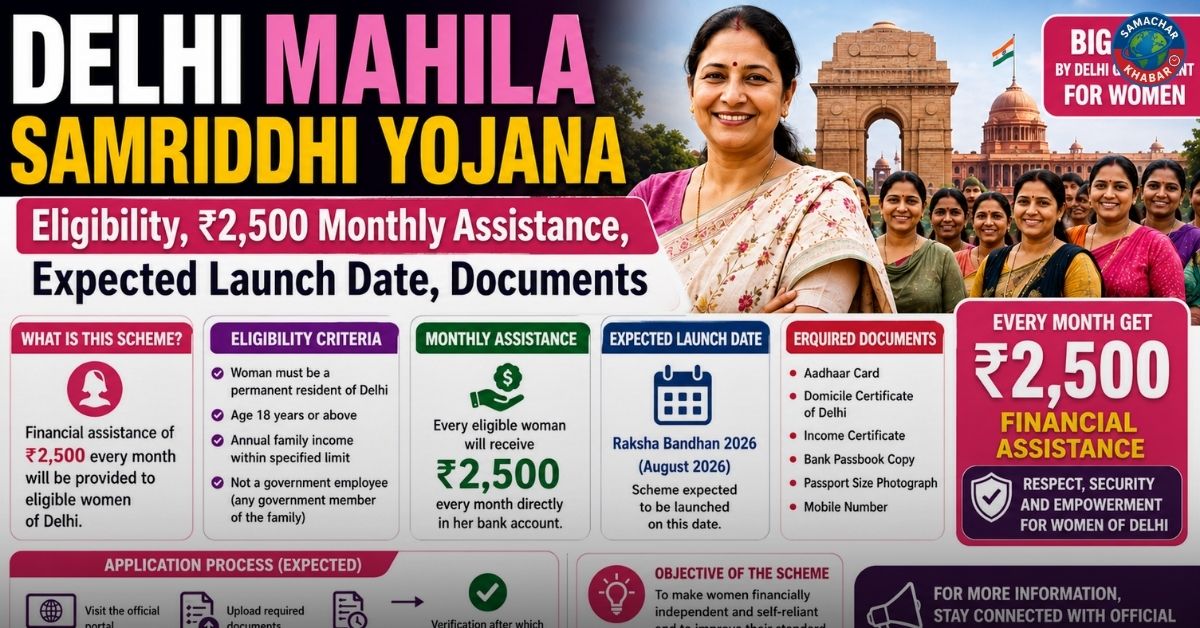
The Delhi government has completed most preparations to roll out the Mahila Samriddhi Yojana, a flagship welfare scheme aimed at providing eligible women with ₹2,500 every month through Direct Benefit Transfer (DBT). The scheme is expected to be formally launched around Raksha Bandhan on August 28, while an online registration portal has already been prepared. The government has also finalized eligibility criteria, required documents, and other conditions for beneficiaries.
Key Takeaways of Delhi Mahila Samriddhi Yojana
- The Delhi government is preparing to launch the Mahila Samriddhi Yojana.
- Eligible women will receive ₹2,500 per month through Direct Benefit Transfer (DBT).
- The scheme is expected to be launched around Raksha Bandhan (August 28).
- An online registration portal has been prepared for applications.
- Women aged 21 to 60 years meeting the eligibility criteria can apply.
- Permanent Delhi residents living in the city for at least five years will be eligible.
- Family annual income should be up to ₹2.5 lakh–₹3 lakh, as per the prescribed eligibility norms.
- Only one woman per family will receive benefits.
- Ration card holders will be given priority.
- Around 20–22 lakh women are expected to benefit.
- Government employees, income taxpayers, women receiving government pensions or similar government scheme benefits, and women owning four-wheelers will not be eligible.
- Applications will be accepted online after the portal opens.
Delhi Mahila Samriddhi Yojana: Complete Details
Delhi Government Completes Preparations for Mahila Samriddhi Yojana
The Delhi government has almost completed preparations for implementing the Mahila Samriddhi Yojana, one of its flagship welfare initiatives for women. An online registration portal has been prepared, and eligibility criteria have been finalized to facilitate the application process.
Under the scheme, eligible women from economically weaker families will receive ₹2,500 every month, with the amount being transferred directly into their bank accounts through the Direct Benefit Transfer (DBT) system.
The scheme received Cabinet approval in March 2025, and the Delhi Budget 2026–27 provided ₹5,110 crore for its implementation.
Expected Launch Around Raksha Bandhan
The registration portal was earlier expected to become operational around June 2026. However, the formal launch is now expected around Raksha Bandhan on August 28.
According to sources, the government is planning to officially launch the scheme during the festival. Reports have also stated that Prime Minister Narendra Modi may launch the scheme, although no official confirmation has been issued.
Also Read: ICAI CA Inter May 2026 Result Declared at caresults.icai.org; Shardul Shekhar Vichare Secures AIR 1
Chief Minister Rekha Gupta said the government wanted to implement the scheme only after completing all necessary preparations so that eligible women could receive benefits without inconvenience.
Who Will Be Eligible for the Scheme?
The Delhi government has finalized the eligibility conditions for beneficiaries.
| Eligibility Criteria | Details |
| Age | 21 to 60 years |
| Residence | Permanent resident of Delhi with at least five years of residence |
| Annual Family Income | Up to ₹2.5 lakh–₹3 lakh, as per prescribed eligibility norms |
| Family Limit | One eligible woman per family |
| Priority | Women holding ration cards |
The government estimates that approximately 20–22 lakh women will benefit from the scheme.
Who Will Not Be Eligible?
Certain categories of women have been excluded from the scheme.
These include:
- Women employed in government jobs.
- Women who own four-wheelers.
- Income taxpayers.
- Women receiving government pensions.
- Women are already receiving benefits under other government schemes.
These eligibility conditions are intended to ensure that financial assistance reaches economically weaker households.
Documents Required for Application
The application process will be completely online.
Applicants are expected to require the following documents:
- Aadhaar Card.
- Aadhaar-linked mobile number.
- Aadhaar-linked bank account/passbook.
- Residence proof such as:
- Voter ID Card.
- Ration Card.
- Income Certificate.
- Passport-size photograph.
The government is expected to release detailed application guidelines after the registration portal officially opens.
Financial Assistance Through Direct Benefit Transfer
Under the Mahila Samriddhi Yojana, financial assistance will be transferred directly into beneficiaries’ bank accounts through the Direct Benefit Transfer (DBT) mechanism.
The government has stated that the scheme aims to provide financial support to women from economically weaker and middle-income families, helping them manage household expenses more effectively.
Implementation Challenges
Like other large welfare programmes, the Mahila Samriddhi Yojana is expected to face administrative challenges.
Also Read: मोबाइल और स्क्रीन का शरीर पर बढ़ता असर, क्या तकनीक धीरे-धीरे बदल रही है हमारे शरीर को?
One of the biggest challenges will be identifying genuine beneficiaries in a city as large as Delhi. Preparing an accurate list of eligible women while preventing the involvement of middlemen is expected to be a significant administrative responsibility.
Why the Scheme Is in Focus
The Mahila Samriddhi Yojana has attracted significant attention because it was one of the Bharatiya Janata Party’s election promises in Delhi.
The government is now moving towards implementing the scheme after completing the required preparations. With the online portal ready and eligibility norms finalized, applicants are now awaiting the official launch and the release of detailed registration guidelines.
Recent reports have also indicated that the government is considering launching the programme under the name “Delhi Laxmi Yojana”. However, no official notification confirming a name change has been issued, and the scheme continues to be referred to as the Mahila Samriddhi Yojana in available official preparations and reports.
What Applicants Should Watch Next
The Delhi government is expected to announce the official launch date, activate the online registration portal, and publish detailed application guidelines. Eligible women should keep their Aadhaar-linked bank accounts, income certificate, residence proof, and other required documents ready before the application process begins. Until an official notification is issued, the expected launch around Raksha Bandhan remains the latest reported timeline.
Spiritual Service Through Selfless Welfare
Beyond government welfare initiatives, many social and spiritual organisations also work to support economically weaker sections of society through humanitarian efforts. According to reports published by SA News, Tatvadarshi Sant Rampal Ji Maharaj is guiding the Annapurna Muhim, which aims to provide essential support such as food, clothing, education and shelter to needy families without discrimination.
SA News has also reported that His Kisan Mazdoor Bachao Abhiyan – Phase 3 is focused on reducing the financial burden on eligible small farmers through a survey and verification process. In a recent implementation in Dhanana village of Sonipat, Haryana, selected farmers received free fertilisers, certified seeds and crop protection materials after verification and online payment to authorised agricultural input centres.
For more information visit our:
- Website: www.jagatgururampalji.org
- YouTube: Sant Rampal Ji Maharaj
- Facebook: Spiritual Leader Saint Rampal Ji
- X (Twitter): @SaintRampalJiM
FAQs on Delhi Mahila Samriddhi Yojana
1. What is the Delhi Mahila Samriddhi Yojana?
It is a proposed Delhi government scheme that aims to provide eligible women with ₹2,500 per month through DBT.
2. When is the Mahila Samriddhi Yojana expected to start?
The scheme is expected to be formally launched around Raksha Bandhan on August 28, subject to official announcement.
3. Who is eligible for the Mahila Samriddhi Yojana?
Women aged 21–60 years who are permanent Delhi residents, meet the prescribed income criteria, and satisfy other eligibility conditions.
4. Which documents are required for the scheme?
Applicants will need Aadhaar, an Aadhaar-linked mobile number, an Aadhaar-linked bank account, residence proof, an income certificate, and a passport-size photograph.
5. How will beneficiaries receive the ₹2,500 assistance?
Eligible beneficiaries will receive the monthly assistance directly into their bank accounts through the Direct Benefit Transfer (DBT) system.








1 thought on “Delhi Mahila Samriddhi Yojana: Eligibility, ₹2,500 Monthly Assistance, Expected Launch Date, Documents and Latest Updates”