India’s agricultural sector is passing through a critical phase where increasing food demand, excessive use of chemical fertilizers, soil degradation, declining groundwater levels, and climate change have become serious concerns. Recognizing the urgent need to conserve agricultural resources and restore soil fertility, the Government of India launched the Khet Bachao Abhiyan 2026, a nationwide campaign dedicated to protecting farmlands, improving soil health, and promoting sustainable agricultural practices.
The campaign has emerged as an important initiative aimed at creating awareness among farmers about balanced fertilizer application, soil testing, natural farming, water conservation, and scientific crop management. It seeks to transform Indian agriculture into a more productive, profitable, and environmentally sustainable system.
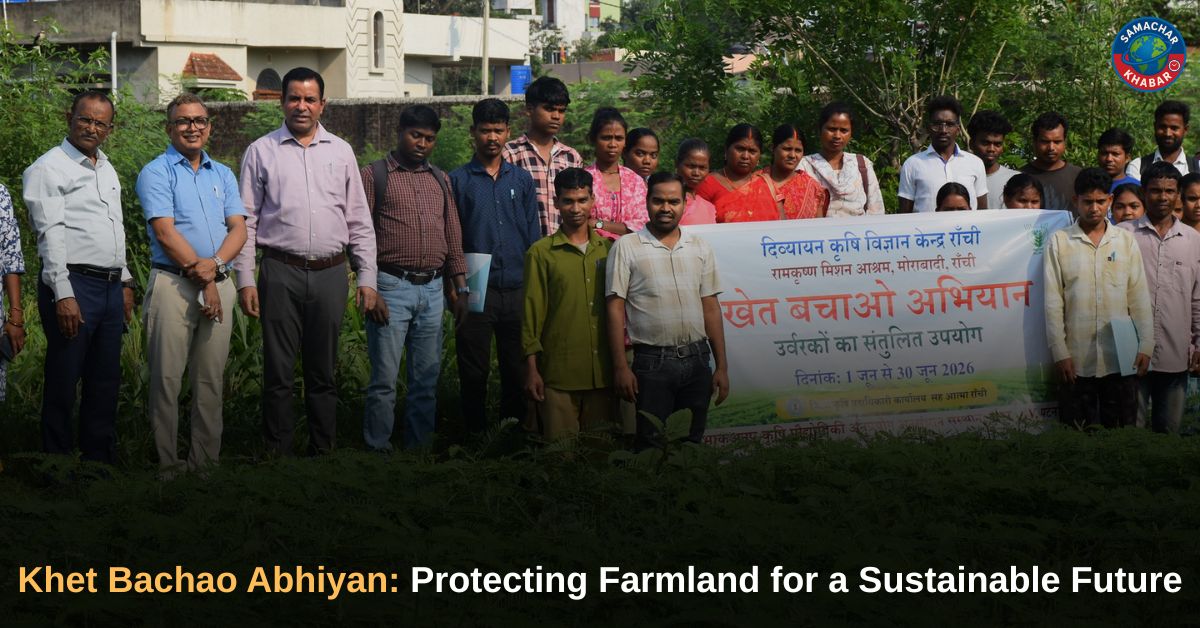
The Khet Bachao Abhiyan 2026 was formally launched on 1 June 2026 at Ramasia village in Raisen district of Madhya Pradesh by the Union Minister for Agriculture and Farmers’ Welfare and Rural Development, Shri Shivraj Singh Chouhan. The campaign is being implemented across the country from 1 June to 30 June 2026 as a month-long mass awareness programme involving agricultural scientists, extension workers, Krishi Vigyan Kendras, state agriculture departments, universities, and farmer organizations.
The primary objective of launching the campaign is to address the growing problem of soil degradation caused by indiscriminate use of chemical fertilizers and unsustainable agricultural practices. Excessive dependence on chemical inputs has increased cultivation costs while gradually reducing soil productivity and damaging its physical, chemical, and biological properties. The campaign encourages farmers to adopt scientific and eco-friendly farming techniques to maintain soil fertility and secure food production for future generations.
Why Khet Bachao Abhiyan Was Started:
India possesses nearly 140 million hectares of cultivable land, but a significant portion is facing deterioration due to erosion, nutrient depletion, salinity, waterlogging, and declining organic carbon content. Continuous monocropping, imbalanced fertilizer application, and inadequate replenishment of nutrients have further aggravated the problem.
Several studies indicate that agricultural soils are gradually losing their productive capacity. Farmers often apply excessive doses of nitrogenous fertilizers in the hope of increasing yields, but this practice leads to nutrient imbalance and lower fertilizer-use efficiency.
The Government of India initiated the Khet Bachao Abhiyan to tackle these issues and encourage farmers to understand that healthy soil is the foundation of sustainable agriculture. Without fertile soil, it will become increasingly difficult to meet the food requirements of a growing population.
The campaign also aims to reduce farmers’ dependence on expensive external inputs and promote cost-effective alternatives such as organic manure, biofertilizers, green manuring, crop rotation, and integrated nutrient management.
Objectives of Khet Bachao Abhiyan 2026:
The campaign has been designed with several important objectives:
- To conserve and improve soil health.
- To promote balanced and need-based fertilizer use.
- To encourage soil testing and utilization of Soil Health Cards.
- To create awareness regarding natural farming practices.
- To increase water-use efficiency in agriculture.
- To promote scientific crop management practices.
- To reduce production costs and improve farmers’ income.
- To encourage sustainable agricultural development.
- To prevent long-term degradation of agricultural lands.
- To strengthen national food security.
Major Activities Conducted Under the Campaign:
Various awareness and capacity-building programmes are being organized under the campaign.
Soil Testing Campaigns:
- Farmers are encouraged to collect soil samples from their fields and send them for laboratory analysis.
- Soil testing helps determine:
- Soil pH
- Organic carbon content
- Available nitrogen
- Phosphorus levels
- Potassium status
- Micronutrient deficiencies
Based on the results, farmers receive recommendations regarding suitable fertilizers and nutrient management strategies.
Distribution and Use of Soil Health Cards:
The Soil Health Card provides information about the nutrient status of the soil and guides farmers regarding the appropriate quantity of fertilizers required for different crops.
By following the recommendations mentioned in the Soil Health Card, farmers can reduce unnecessary expenditure on fertilizers and maintain soil productivity.
Awareness on Balanced Fertilizer Application:
The campaign emphasizes balanced nutrient application rather than excessive use of nitrogen fertilizers.
Farmers are advised to apply fertilizers according to the 4R Nutrient Stewardship Principles:
- Right source
- Right dose
- Right time
- Right method
Integrated nutrient management practices are also promoted.
Promotion of Natural Farming:
Natural farming has gained importance because it reduces dependence on chemical inputs and utilizes locally available resources.
Under the campaign, farmers are trained in the preparation and application of:
- Jeevamrut
- Beejamrut
- Ghana Jeevamrut
- Vermicompost
- Panchagavya
Natural farming improves microbial activity, increases organic matter, and enhances soil structure.
Water Conservation Activities:
Water scarcity is becoming a major challenge in many regions.
Farmers are educated about:
- Drip irrigation
- Sprinkler irrigation
- Farm ponds
- Rainwater harvesting
- Mulching
- Laser land leveling
Efficient water management ensures better crop growth and minimizes wastage.
Role of Krishi Vigyan Kendras:
Krishi Vigyan Kendras are playing an important role in implementing the campaign at the grassroots level.
Scientists and extension specialists conduct:
- Farmer meetings
- Demonstrations
- Field visits
- Training programmes
- Soil sample collection drives
- Awareness rallies
KVKs provide technical guidance regarding scientific nutrient management, crop diversification, and integrated farming systems.
Scope of Sustainable Agriculture in India:
India is the world’s second-largest producer of food grains and supports a large agricultural population.
However, challenges such as climate variability, declining natural resources, and rising production costs necessitate a shift toward sustainable agriculture.
Practices promoted under the Khet Bachao Abhiyan include:
Crop Rotation
Growing different crops in succession helps maintain soil fertility and reduce pest incidence.
Examples include:
- Soybean–Wheat
- Maize–Chickpea
- Paddy–Mustard
Green Manuring
Green manure crops improve soil organic matter and nutrient availability.
Common green manure crops include:
- Sunhemp
- Dhaincha
- Cowpea
- Agroforestry
Integration of trees with crops offers several advantages.
Benefits include:
- Reduced soil erosion
- Increased carbon sequestration
- Improved biodiversity
- Additional farm income
- Conservation Agriculture
Conservation agriculture involves:
- Minimum soil disturbance
- Permanent soil cover
- Crop diversification
These practices improve soil moisture retention and enhance resilience against climate change.
Benefits of Khet Bachao Abhiyan:
The campaign offers numerous benefits to farmers and the environment.
- Improved Soil Fertility: Balanced nutrient management restores the physical and biological properties of soil.
- Reduced Input Costs: Scientific fertilizer recommendations help farmers save money.
- Increased Crop Productivity: Healthy soils support better plant growth and higher yields.
- Environmental Protection: Reduced chemical use lowers pollution and greenhouse gas emissions.
- Better Water Management: Efficient irrigation practices conserve water resources.
- Enhanced Farmers’ Income: Lower production costs and improved productivity increase profitability.
- Long-Term Food Security: Healthy agricultural land ensures sustainable food production for future generations.
Participation of Farmers:
Farmers are the backbone of the campaign.
Their active participation determines the success of the programme.
Farmers can contribute by:
- Conducting regular soil testing.
- Following Soil Health Card recommendations.
- Adopting natural farming techniques.
- Reducing excessive fertilizer use.
- Conserving irrigation water.
- Participating in training programmes.
- Sharing knowledge with fellow farmers.
Achievements of the Campaign:
The campaign has received an encouraging response from farming communities across the country.
According to reports, more than 9.42 lakh farmers have already participated in awareness activities, while thousands of demonstrations, training programmes, and field visits have been organized. The campaign has also reached millions of people through digital media, seminars, and extension activities.
Challenges Ahead:
Despite its positive impact, certain challenges remain.
These include:
- Limited awareness among small farmers.
- Financial constraints
- Inadequate access to soil testing laboratories.
- Shortage of extension personnel.
- Climate-related uncertainties.
- Dependence on conventional farming practices.
Addressing these issues will require continuous efforts from government agencies, research institutions, and farming communities.
Role of Sant Rampal Ji Maharaj in Khet Bachao Abhiyan:
Sant Rampal Ji Maharaj has consistently expressed his commitment to supporting farmers and laborers, emphasizing that they should not be left to suffer during times of hardship. He has encouraged his followers to extend every possible form of assistance to the farming community and agricultural workers. Whenever floods, natural disasters, or other agriculture-related challenges affect farmers, efforts inspired by his teachings have often been directed toward providing relief and support. In this context, his vision of standing with farmers and promoting their welfare can be seen as contributing, both directly and indirectly, to the objectives of the Khet Bachao Abhiyan by encouraging community participation, humanitarian service, and assistance for those dependent on agriculture.
Final Thoughts:
The Khet Bachao Abhiyan 2026 is not merely a campaign but a national mission aimed at preserving India’s most valuable resource, its soil. Healthy soil is essential for ensuring sustainable agriculture, increasing farmers’ income, protecting the environment, and guaranteeing food security for future generations.
By promoting balanced fertilizer use, soil testing, natural farming, water conservation, and scientific crop management, the campaign seeks to transform Indian agriculture into a resilient and environmentally friendly sector. The success of this initiative depends on the collective participation of farmers, scientists, extension workers, educational institutions, and policymakers.
If implemented effectively, the Khet Bachao Abhiyan can become a milestone in India’s journey toward sustainable agricultural development and a prosperous future for millions of farming families.
FAQs – Khet Bachao Abhiyan 2026
Q1. What is Khet Bachao Abhiyan 2026?
Ans: Khet Bachao Abhiyan 2026 is an awareness and conservation initiative aimed at protecting agricultural land, improving soil health, and promoting sustainable farming practices.
Q2. Why is Khet Bachao Abhiyan important?
Ans: The campaign is important because agricultural land is shrinking due to urbanization, industrialization, and soil degradation, which can threaten food security and farmers’ livelihoods.
Q3. What are the main objectives of Khet Bachao Abhiyan 2026?
Ans: The main objectives include conserving farmland, preventing soil erosion, improving soil fertility, encouraging organic farming, and creating awareness among farmers and communities.
Q4. Who can participate in the campaign?
Ans: Farmers, students, agricultural experts, village communities, environmental organizations, and concerned citizens can participate in the campaign.
Q5. How can farmers contribute to protecting their fields?
Ans: Farmers can adopt sustainable agricultural practices such as crop rotation, organic manure application, efficient water management, and soil testing.
Q6. How does soil conservation benefit farmers?
Ans: Soil conservation helps maintain soil fertility, increases crop productivity, reduces input costs, and ensures long-term agricultural sustainability.
Q7. Can individuals living in urban areas support the campaign?
Ans: Yes. Urban residents can support the campaign by spreading awareness, consuming responsibly, supporting local farmers, and advocating for farmland conservation policies.
Q8. What message does Khet Bachao Abhiyan 2026 convey?
Ans: The campaign conveys the message: “Save farmland today to secure food and livelihoods for future generations.”