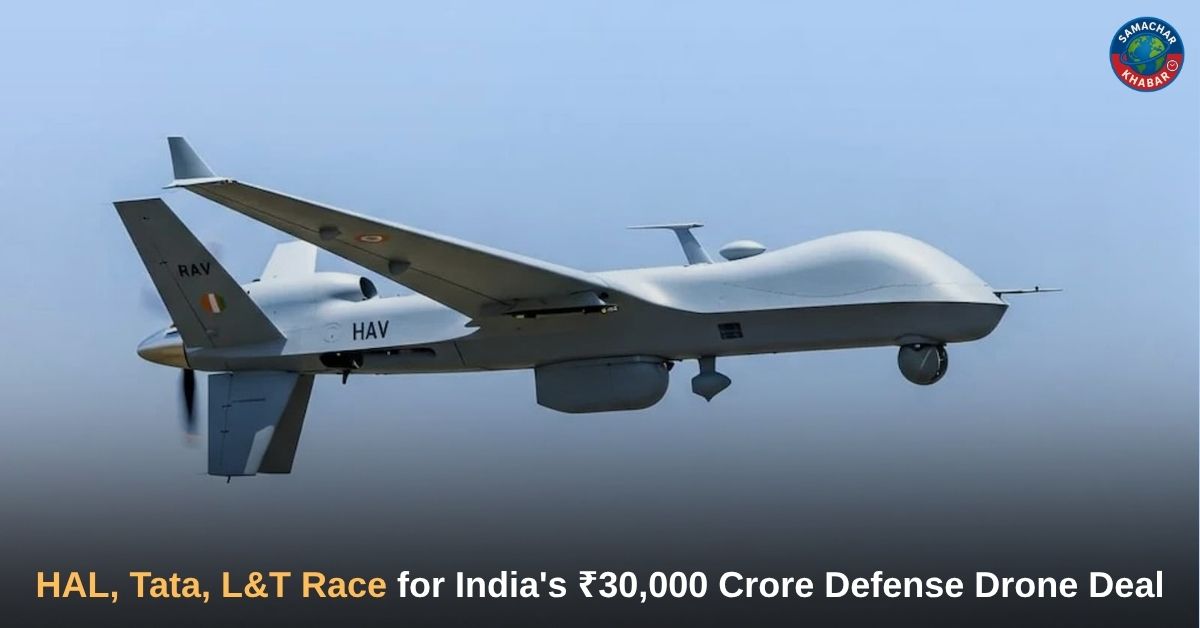
In a massive push for self-reliance in defense manufacturing, India is gearing up for one of its most ambitious military acquisitions to date. Bidding has officially closed for a staggering ₹30,000 crore project designed to equip the Indian Air Force (IAF) with 87 advanced Medium-Altitude Long-Endurance (MALE) drones.
As the June 16 submission deadline wrapped up, roughly 10 major domestic defense giants threw their hats into the ring, signaling a monumental shift away from importing foreign military tech. With heavyweights like Hindustan Aeronautics Limited (HAL), Tata Advanced Systems, and Larsen & Toubro (L&T) competing, this mega-deal is poised to reshape the landscape of the Indian aerospace industry.
Key Points at Glance
- The Mega Deal: The defense ministry is seeking to procure 87 MALE drones for the IAF, in a project valued at over ₹30,000 crore.
- The Contenders: Around 10 Indian public and private firms submitted bids, including HAL, Tata Advanced Systems, L&T, Adani Defence Systems, Solar Defence and Aerospace, and Raphe mPhibr.
- Dual Production Lines: To ensure faster deliveries and robust supply chains, the government is reportedly planning to divide the final order between the two lowest bidders in a 64:36 split.
- Advanced Capabilities: These homegrown drones will be equipped for real-time intelligence, surveillance, and reconnaissance (ISR) and will be integrated with indigenous missile systems for precision strikes.
- Strategic Shift: The project aims to end India’s long-standing reliance on foreign drone suppliers like the United States and Israel.
A Milestone for ‘Make in India’
For years, the Indian armed forces have leaned heavily on high-end unmanned platforms imported from nations like the US and Israel to monitor hostile borders. However, the defense ministry cleared this new program last year strictly under the Indigenously Designed, Developed, and Manufactured (IDDM) category. The goal is simple but profound: push Indian manufacturers to not just assemble, but design and build lethal, high-tech platforms entirely on home soil.
The defense ministry even extended the bidding timelines twice, giving domestic companies the crucial breathing room needed to put together highly competitive and credible technical responses. This highlights the government’s unwavering commitment to ensuring an Indian company wins the contract, rather than rushing to award it to a foreign vendor.
Eyes in the Sky, Missiles on the Wings
What exactly is the IAF looking for? The armed forces finalized their specifications following a comprehensive scientific study. The military requires a fleet of drones capable of loitering at high altitudes for extended periods perfect for maintaining a persistent watch over the rugged, high-altitude northern frontiers with China and monitoring constant infiltration threats along the western border with Pakistan.
These MALE drones won’t just be passive observers carrying synthetic aperture radar and electro-optical payloads. Crucially, officials have revealed plans to integrate them with indigenous missile systems. This turns the drones into hunter-killers, allowing the military to spot an enemy target in real-time and eliminate it using homegrown weaponry, thereby keeping the entire “kill chain” securely within the country.
Building a Drone Ecosystem
The sheer scale of this ₹30,000 crore (over $2 billion) program makes it a lucrative prize for the industry. But the government is playing it smart. Rather than handing a monopoly to a single winner, reports indicate the order will likely be split. The lowest bidder could secure 64% of the order, while the second-lowest takes the remaining 36%.
This strategy guarantees the establishment of two independent production lines. Not only does this prevent manufacturing bottlenecks, but it also secures the national supply chain in case one company faces operational hurdles later on. Furthermore, while the initial order is for 87 units, future requirements could push the total demand to a massive 350 drones.
As we move past this June 2026 bidding deadline, the selected drones will now undergo rigorous, trial-by-fire testing by the Indian Air Force. Whichever firms emerge victorious will not only secure a historic payday but will permanently elevate India’s status as a global hub for advanced defense manufacturing.
The Path to Lasting World Peace
While India’s growing defense capabilities are vital for national security, building a truly peaceful and prosperous world requires something even deeper: a transformation in human thinking and values. This is the vision that Sant Rampal Ji Maharaj is working to achieve. Through His spiritual teachings, He is inspiring people to rise above divisions of caste, religion, language, and nationality, and embrace a society founded on compassion, equality, brotherhood, and moral living.
Sant Rampal Ji Maharaj teaches that only spiritual knowledge rooted in the scriptures can bring lasting peace to humanity. He has presented evidence from the sacred texts of multiple religions to explain that Kabir Saheb, who appeared on Earth around 600 years ago, is the Supreme God. According to His teachings, the true method of worship described in all holy scriptures can unite humanity under one spiritual truth and lay the foundation for Adi Sanatan Dharma, a world where people live in harmony, free from hatred, violence, and discrimination.
To understand this scriptural knowledge, learn the true path of devotion, and explore the teachings that aim to unite the world, download the Sant Rampal Ji Maharaj App from the Google Play Store. The app offers free spiritual discourses, books, videos, and valuable guidance for leading a peaceful and meaningful life.
FAQs Related to Defense Drone Deal
1. What is the ₹30,000 crore defense drone deal?
It is a massive procurement project cleared by the Indian Defense Ministry to acquire 87 Medium-Altitude Long-Endurance (MALE) drones specifically for the Indian Air Force. The project strictly promotes domestic manufacturing to reduce reliance on foreign imports.
2. Which Indian companies are participating in the bidding?
Around 10 public and private sector firms submitted bids before the June 16, 2026, deadline. Key contenders include Hindustan Aeronautics Limited (HAL), Tata Advanced Systems Limited, Larsen & Toubro (L&T), Adani Defence Systems, Solar Defence and Aerospace, and Raphe mPhibr.
3. What will these new MALE drones be used for?
The drones will serve as persistent “eyes in the sky,” providing real-time intelligence, surveillance, and reconnaissance (ISR) along India’s borders with Pakistan and China. Furthermore, there are plans to integrate them with indigenous missile systems to carry out precision strikes against hostile targets.
4. Will the entire ₹30,000 crore contract be awarded to one company?
Reports suggest the government plans to split the final order in a 64:36 ratio between the two lowest bidders. This strategy aims to establish two independent production lines, reducing manufacturing bottlenecks and securing the defense supply chain.
5. Why doesn’t India just buy these drones from other countries?
Historically, India relied heavily on the US and Israel for advanced drones. However, the government mandated this project under the Indigenously Designed, Developed, and Manufactured (IDDM) category to promote long-term self-reliance, build a robust domestic defense industry, and keep sensitive “kill chain” technology fully under national control.