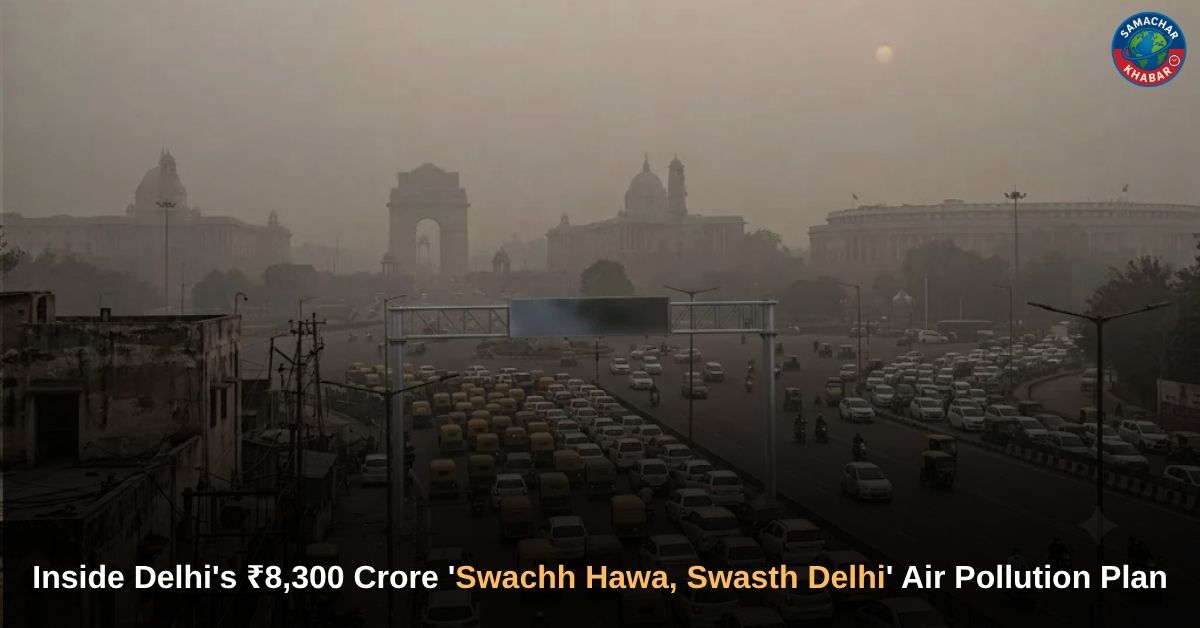
For anyone who has lived in the national capital, the annual arrival of winter brings a familiar, suffocating dread. Year after year, Delhi claims the unfortunate title of the world’s most polluted capital city. However, the local administration is attempting to flip the script with a proactive, financially massive intervention.
The Delhi government has officially launched the ‘Clean Air, Healthy Delhi’ (Swachh Hawa, Swasth Delhi) programme, a comprehensive seven-year action plan backed heavily by the World Bank. Unlike previous reactive measures that only kicked in when the Air Quality Index (AQI) hit emergency levels, this structured roadmap promises deep institutional reforms and technological overhauls months before the winter smog sets in. But with a history of failed quick fixes, the real question remains: will this massive investment finally clear the skies, or will it vanish into the urban haze?
Key Points of ‘Swachh Hawa, Swasth Delhi’ Master Plan
- The Delhi government has approved a massive ₹8,300-crore budget for the seven-year clean air initiative.
- The project is scheduled to be implemented between September 2026 and August 2033.
- The World Bank will provide 65% of the financing through a loan, while the Delhi government will bear the remaining 35%.
- From November 1, 2026, the entry of goods vehicles into Delhi will be strictly restricted to those compliant with BS-VI emission norms, CNG, or electric power.
- The government plans to decongest 62 identified traffic hotspots and implement staggered office timings or work-from-home directives during severe pollution spells.
The Financial and Administrative Blueprint
The sheer scale of the ‘Swachh Hawa, Swasth Delhi’ initiative makes it one of the most ambitious urban environmental projects in Indian history. Chief Minister Rekha Gupta emphasized that this ₹8,300-crore initiative is not merely a short-term pollution control tactic, but a long-term investment in public health and a sustainable urban future.
Administratively, the project is divided into two distinct components. The first component is heavily focused on governance and data. A dedicated Project Management Unit (PMU) will be established to ensure the mission is executed on time. Furthermore, the city will see the development of advanced air quality monitoring systems and an Integrated Command and Control Centre (ICCC) to track real-time pollution data and coordinate between various civic agencies.
Targeting the Sources: Vehicles, Dust, and Waste
The second component of the plan takes direct aim at the primary villains of Delhi’s air: vehicular emissions, road dust, and construction waste.
To curb tailpipe emissions, the government is taking a hardline approach. Beginning November 1, only BS-VI compliant, electric, or CNG goods vehicles will be allowed to enter the city borders. Additionally, a strict “No PUC, No Fuel” rule will be enforced using ANPR cameras and digital tracking. To reduce reliance on private transport, the government aims to expand its bus fleet to a staggering 13,760 vehicles by 2028-29, with a heavy priority on electric buses.
Dust control is another major priority. The plan proposes deploying mechanical road sweepers, water sprinklers, and anti-smog guns, alongside redeveloping nearly 3,500 kilometers of roads with paved surfaces and green buffers.
Hope vs. Historical Hurdles
While the blueprint is undeniably robust on paper, skepticism remains high among environmentalists and citizens alike. Successive governments have historically struggled to match the sheer scale of the pollution crisis, often relying on localized, ineffective measures like smog towers.
The success of the new plan will depend entirely on its ground-level execution. For instance, while deploying mechanical road sweeping machines (MRSMs) is a key feature of the new plan, a recent investigation revealed that Delhi’s existing sweeper fleet is vastly underpowered, falling 80% short of the 505 machines recommended by the Prime Minister’s Office. The investigation also noted that these machines frequently operated below capacity, covering only a fraction of the city.
Furthermore, experts argue that Delhi cannot solve this problem in isolation. The national capital is part of a much larger “airshed” that stretches across northern India. Without stringent coordination with neighboring states to curb industrial discharge and seasonal biomass burning, Delhi’s internal efforts may only yield limited results.
The ‘Swachh Hawa, Swasth Delhi’ plan is undoubtedly a step in the right direction. It signals a shift from panic-driven red alerts to proactive, science-based urban management. However, the true test will not be how much money is spent, but whether the government can enforce these strict rules seamlessly across the sprawling metropolis.
The Invisible Pollution Within Us
While governments can introduce policies to reduce pollution and make cities cleaner, Sant Rampal Ji Maharaj teaches that lasting peace and harmony begin with cleansing the mind. According to his spiritual discourses, the real pollutants in human life are Kaam (lust), Krodh (anger), Lobh (greed), Moh (attachment), and Ahankar (ego). These inner impurities not only disturb an individual’s peace but also contribute to conflict, corruption, violence, and social unrest.
Sant Rampal Ji Maharaj explains, through the evidence of holy scriptures, that true devotion to the Supreme God helps a person overcome these negative tendencies and develop qualities such as compassion, honesty, self-control, and kindness. Just as a clean environment is essential for a healthy body, a pure mind is essential for a peaceful and meaningful life.
To understand the spiritual wisdom behind inner transformation and true devotion, download the Sant Rampal Ji Maharaj App. The app provides free spiritual discourses, sacred literature, and scriptural knowledge to help individuals lead a happier, more disciplined, and spiritually enriched life.
FAQs on ‘Swachh Hawa, Swasth Delhi’ Master Plan
1. What is the ‘Swachh Hawa, Swasth Delhi’ initiative?
It is a comprehensive, seven-year air pollution mitigation programme launched by the Delhi government, running from September 2026 to August 2033, aimed at tightening air quality management and cutting major emission sources.
2. How is the ₹8,300 crore clean air project being funded?
The project operates on a shared financial model, where the World Bank is providing a loan to cover 65% of the total ₹8,300 crore cost, and the Delhi government is financing the remaining 35%.
3. What new rules apply to commercial vehicles entering Delhi?
As part of the plan’s strict enforcement, starting November 1, 2026, the entry of goods vehicles into Delhi will be restricted exclusively to those that are compliant with BS-VI emission norms, or those powered by CNG or electricity.
4. How will the government tackle road dust pollution?
The plan includes deploying a larger fleet of mechanical road sweepers, water sprinklers, and anti-smog guns. Additionally, the government intends to redevelop nearly 3,500 kilometers of city roads by adding paved surfaces and green buffers to minimize dust generation.
5. Why are environmentalists skeptical about the plan’s success?
While the plan is comprehensive, past localized interventions like smog towers failed to make a substantial impact. Furthermore, investigations have shown poor execution in the past, such as mechanical sweeping fleets operating at 80% below the recommended capacity. Experts also stress that Delhi’s pollution is an “airshed” problem requiring regional coordination, not just city-level fixes.